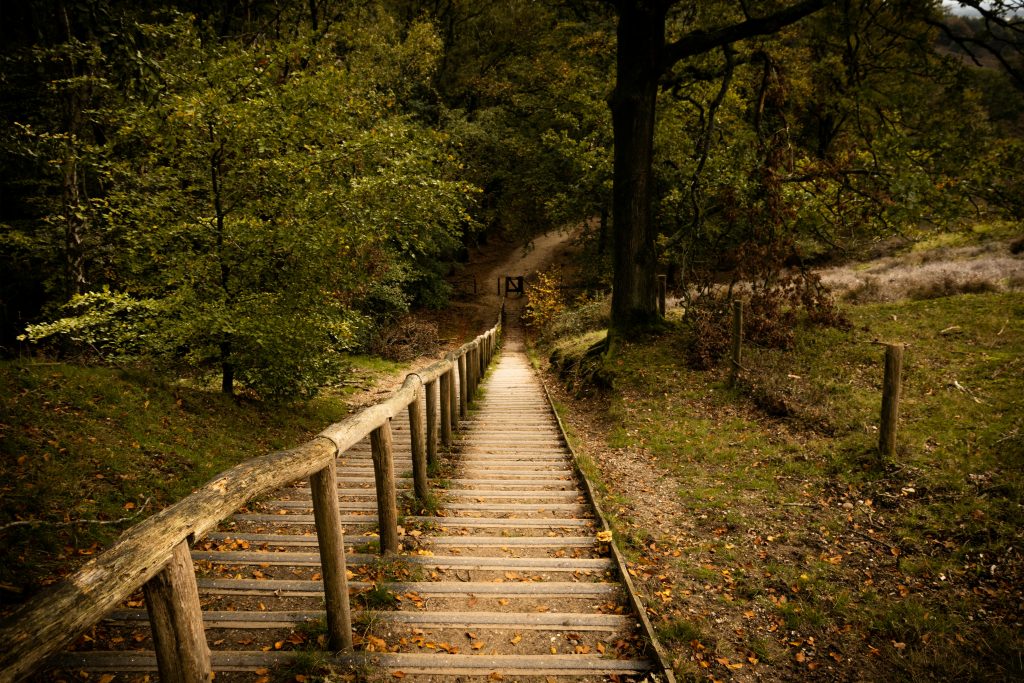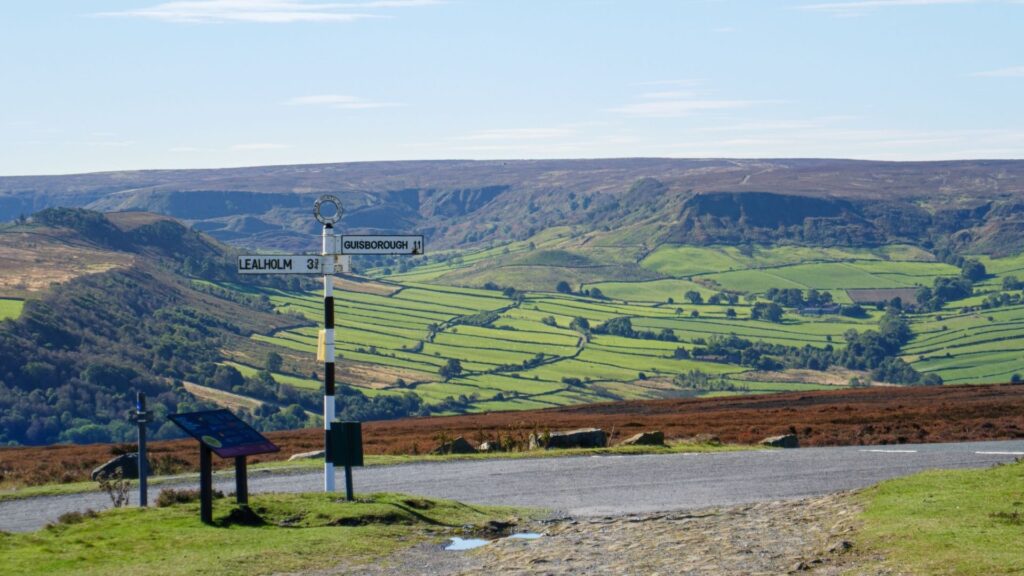
The North York Moors offers some of the best walking in northern England, combining heather-covered moorland, wooded valleys, dramatic coastline and traditional Yorkshire villages.
These five walks range from short summit climbs and family-friendly valley routes to the spectacular Cleveland Way coast and the challenging 40-mile Lyke Wake Walk.
- Why Hike in the North York Moors?
- 1. Best Short Summit Walk: Roseberry Topping
- 2. Best Family Walk: The Hole of Horcum
- 3. Best Spring Walk: Farndale Daffodil Walk
- 4. Best Coastal Walk: Whitby to Robin Hood’s Bay
- 5. Best Long-Distance Challenge: Lyke Wake Walk
- When Is the Best Time to Walk in the North York Moors?
- What to Bring Walking in the North York Moors
- Conclusion
- Where to Next?
Why Hike in the North York Moors?
The North York Moors are one of those places that manage to feel both wild and welcoming at the same time.
On one side you have vast rolling hills covered in heather, and then on the other, you’ve got cozy villages where the pubs feel like a reward for finishing your hike.
For those of you who enjoy landscapes that seem to stretch on forever, this is the place to be in the UK since it’s a patchwork of valleys, ridges, ancient woodlands, and windswept plateaus where every bend in the path seems to offer something different.
But what really makes hiking in this corner of Yorkshire so special is how down-to-earth it all feels. These aren’t inaccessible mountain peaks that require crampons and weeks of preparation.
These are trails that welcome families, solo walkers, dog lovers, and hardened trekkers alike, making the region a great place to experience some of the best hikes in England.
You can climb up a peak that looks impossible from a distance…then be back down in time for tea and cake!
If you’re planning to explore more of the country beyond Yorkshire, our guide to hiking in England is a useful starting point for discovering other regions, routes, and walking opportunities.
So with all that said, here are the top five hikes in the Yorkshire Moors that you’ll want to check out:
“First time on the trail? Hiking for Beginners has your back.”
1. Best Short Summit Walk: Roseberry Topping
Roseberry Topping may look like a mountain, but it’s really a friendly little hill that makes a perfect introduction to the moors.
Its iconic cone-shaped peak rises above the landscape like Yorkshire’s very own Matterhorn, and the climb is just challenging enough to feel like an achievement without overwhelming beginners.
Families, casual walkers, and anyone who wants a quick hit of fresh air will find this one rewarding.
If you’re new to walking trails, you can also check out our before setting off.. For those of you who enjoy hikes with a big payoff for not too much effort, this is the one to try!
Roseberry Topping Details
- Difficulty: Easy to moderate
- Average time: 1–2 hours
- Distance: Approx. 4 km / 2.5 miles
- Elevation gain: Approx. 213 m / 700 ft
- Route type: Short loop or out-and-back depending on route
- Start/end: Newton under Roseberry area
- Highest point: Roseberry Topping, 320 m / 1,050 ft
- Best for: A short summit walk with a big viewpoint
- Highlights: Sweeping views across the surrounding countryside, distinctive summit and open moorland
- Trail highlight: The summit panorama stretching across the Vale of Mowbray and towards Teesside
- Don’t miss: The chance to spot grouse and skylarks along the slopes
2. Best Family Walk: The Hole of Horcum
The Hole of Horcum is the kind of walk that fires up imaginations.
This enormous natural amphitheater, which was carved by glacial meltwater and is now steeped in local legend, is sometimes called the “Devil’s Punchbowl.”
Kids love the story that a giant scooped it out in anger, and adults love the dramatic landscape that feels far more exotic than its modest location suggests.
It’s a gentle and family-friendly loop that mixes wide-open views with tucked-away woodland paths, which makes it very ideal for those of you who want a day in nature but without really pushing your stamina too far.
The Hole of Horcum Details
- Difficulty: Easy to moderate
- Average time: 3–4 hours
- Distance: Approx. 8 km / 5 miles
- Elevation gain: Approx. 180 m / 600 ft
- Route type: Loop
- Start/end: Hole of Horcum car park
- Best for: Families, dramatic scenery and a classic North York Moors circuit
- Highlights: The huge natural amphitheatre, moorland views, woodland and Levisham Estate
- Trail highlight: Looking down into the 400-foot-deep Hole of Horcum from the rim at the beginning of the walk
- Don’t miss: Levisham village, where a pub stop will round off the day nicely!
3. Best Spring Walk: Farndale Daffodil Walk
If you like springtime walks with a splash of color, the Farndale Daffodil Walk is unbeatable.
Each March and April, the valley floor along the River Dove explodes with wild daffodils, and the path becomes a golden ribbon winding through the countryside.
The trail is short and sweet (and also not to mention incredibly scenic), which makes it a perfect half-day outing.
Families with children, couples, or anyone in search of a quick and cheerful walk from Helmsley will find this one hard to beat!
Farndale Daffodil Walk Details
- Difficulty: Easy
- Average time: Approx. 1.5–2 hours
- Distance: Approx. 6 km / 3.7 miles return
- Elevation gain: Approx. 60–65 m / 197–213 ft
- Route type: Out-and-back
- Start/end: Low Mill, Farndale
- Turnaround point: Church Houses
- Best for: Spring flowers, families and an easy riverside walk
- Highlights: Wild daffodils, River Dove and the Farndale valley
- Trail highlight: Thousands of native wild daffodils lining the riverbanks during their spring flowering season
- Don’t miss: A riverside picnic, especially when the sun breaks through
4. Best Coastal Walk: Whitby to Robin Hood’s Bay
The Cleveland Way is the crown jewel of North York Moors hiking, and while the full 109 miles might be a little much for most, a single-day section makes for an unforgettable adventure.
The stretch between Whitby and Robin Hood’s Bay is a particular favorite because it offers some of the best coastal hiking in England.
It’s the sort of walk that combines natural drama with seaside charm, and where every headland gives you another jaw-dropping view
Because this is a longer coastal outing, it’s worth planning your pack carefully and checking our guide to day hiking essentials before you go.
For those of you who like a hike that feels like a journey, this is the one to lace up for!
Whitby to Robin Hood’s Bay Details
- Difficulty: Moderate
- Average time: 5–6 hours
- Distance: Approx. 11 km / 7 miles
- Elevation gain: Approx. 335 m / 1,100 ft
- Route type: Point-to-point
- Start point: Whitby
- End point: Robin Hood’s Bay
- Best for: Coastal scenery and a point-to-point day walk
- Highlights: North Sea cliffs, coastal headlands and the Cleveland Way
- Trail highlight: The long clifftop sections overlooking the North Sea before the final descent towards Robin Hood’s Bay
- Don’t miss: Finishing in Robin Hood’s Bay, where cobbled streets lead down to the beach and the pubs feel like a reward
5. Best Long-Distance Challenge: Lyke Wake Walk
Now for the serious one. The Lyke Wake Walk is a rite of passage, a 40-mile trek across the moors from Osmotherley to Ravenscar that many hikers aim to do in a single day.
But for those of you who like a challenge spread out over two days, breaking it into an overnight adventure makes it manageable and memorable.
It’s tough, it’s wild, and it’s remote, and it has sections that will test your endurance and navigation skills.
It’s tough, it’s wild, and it’s remote, and it has sections that will test your endurance and navigation skills.
If you’re planning to tackle the route, it’s worth taking time to build hiking endurance before your trip.
Lyke Wake Walk Details
- Difficulty: Difficult
- Average time: 2 days, or one very long day for experienced challenge walkers
- Distance: Approx. 64 km / 40 miles
- Elevation gain: Approx. 1,220 m / 4,000 ft across the route
- Route type: Point-to-point
- Start: Osmotherley / western edge of the North York Moors
- End: Ravenscar area on the North Sea coast
- Best for: Experienced walkers looking for a major endurance challenge
- Highlights: Open moorland, long-distance views and a complete crossing of the North York Moors
- Trail highlight: Crossing from the western moors all the way to the North Sea gives the route a genuine journey-like feel
- Don’t miss: The satisfaction of reaching the coast after crossing the moors on foot
For a route of this length, hydration also deserves some planning, so take a look at these hiking hydration tips before heading onto the moors
When Is the Best Time to Walk in the North York Moors?
April to October offers the broadest range of good walking conditions in the North York Moors, although the best month depends on whether you want spring flowers, summer moorland or cooler long-distance walking.
March and April are the months to target if the Farndale Daffodil Walk is one of your priorities. The valley’s famous wild daffodils generally flower between mid-March and mid-April, although the exact timing varies with the weather.
May and June bring long daylight hours, greener valleys and generally comfortable temperatures. This is one of the best periods for longer walks before the busiest part of summer.
July and August offer the longest, warmest days, while late summer also brings colour to the North York Moors’ extensive heather-covered landscapes.
September and October are excellent for cooler walking conditions, quieter paths and autumn colour through wooded valleys.
Winter can still produce some beautiful walking days, but exposed moorland can be cold, wet and windy, while mud, poor visibility and shorter daylight hours make longer routes more demanding.
For major outings such as the Lyke Wake Walk or exposed coastal sections, check the forecast and current trail conditions before setting out.
“From Alps to coastlines, our free Walking Holiday guide helps you plan smarter.”
What to Bring Walking in the North York Moors
The North York Moors rarely involves extreme elevation, but conditions can change quickly between sheltered valleys, exposed moorland and the coast.
Mud, wind and rain are often more important considerations than outright altitude.
For most walks, consider bringing:
- Comfortable walking shoes or hiking boots with enough grip for muddy paths, rocky climbs and uneven moorland
- A waterproof jacket for the region’s changeable weather and exposed sections
- A practical layering system so you can adjust between sheltered valleys and colder ridges
- A 20–30L daypack for food, water and spare clothing
- Enough water for your route, particularly on long moorland stretches where facilities can be limited
- Offline maps or GPS navigation for longer or more remote routes
- Trekking poles if you prefer extra stability on steep, muddy or uneven sections
- Sun protection during longer spring and summer walks
Navigation deserves particular attention on the Lyke Wake Walk, where long stretches cross open moorland and conditions can reduce visibility.
🗒️ Free Checklist: “Never forget the essentials — grab your free Ultimate Hiking Packing List.”
Conclusion
The North York Moors offer hikes for every mood and every kind of walker. For those of you who enjoy a quick climb with sweeping views, Roseberry Topping is perfect.
Families looking for an easy day out will love the Hole of Horcum, and spring visitors can’t go wrong with the Farndale Daffodil Walk.
But the best part? No matter which trail you choose, there’s always a pub, a bakery, or a cozy bed waiting nearby to make your Yorkshire walking holiday even sweeter
Where to Next?
Planning more walking around Yorkshire and England? These guides will help you continue the trip:
- Hiking in Yorkshire: A Walker’s Guide — plan where to walk, when to visit and how the region’s main hiking areas fit together.
- Best Walks in Yorkshire — discover more standout routes across the wider county.
- Best Circular Walks in Yorkshire — find routes that bring you back to your starting point without retracing the whole walk.
- Ultimate Guide to Hiking in England — explore more of England’s major walking regions and trail types.